

Quick Answers
AEO is a search marketing strategy focused on optimizing content for AI-driven "Answer Engines" like ChatGPT, Perplexity, and Google AI Overviews. Unlike traditional SEO, which aims for link clicks, AEO aims to have your brand’s data synthesized into the direct answer provided by an AI. Achieving this requires a combination of high-authority brand mentions, structured data (Schema), and semantic relevance within an AI’s training model.
If you’ve spent any time reading up on digital marketing lately, you’ve probably heard the whispers (or the shouts): “SEO is dead.”
Every few years, a new technology arrives, and the doomsayers come out in full force. We heard it when social media exploded, we heard it when voice search arrived, and now, we’re hearing it because of Generative AI.
But here’s the truth from the front lines: SEO isn’t dying; it’s undergoing its most significant transformation since the invention of the backlink. We are moving away from a world of "Search Engines" and moving toward a world of "Answer Engines."
For South African businesses, this shift represents a massive opportunity. While your competitors are still obsessing over keyword density for "coffee shop Cape Town," the real winners are optimizing for the AI models that are actually making the recommendations.
Welcome to the era of AEO (Answer Engine Optimization) and LLM Optimization.
What Exactly is AEO (And Why Should You Care)?

Traditional SEO is designed to help a website rank in the "Ten Blue Links" on a Google Search Results Page (SERP). You provide great content, Google indexes it, and a user clicks your link to find their answer.
AEO (Answer Engine Optimization)changes the goalpost. Instead of trying to get a user to click a link, AEO is the process of optimizing your brand’s information so that an AI—like ChatGPT, Perplexity, or Google’s AI Overviews—can synthesize your content and provide a direct answer to the user.
According to a study by Gartner, traditional search engine volume is predicted to drop by 25% by 2026 as users pivot toward AI assistants.
If your website isn't optimized to be the source of those AI-generated answers, you aren't just losing rank; you're becoming invisible.
The Rise of the LLM: How ChatGPT and Gemini "See" Your Brand
To understand how to rank in 2026 and beyond, you have to understand LLMs (Large Language Models). When someone asks ChatGPT, "Who is the best supplement brand in South Africa?", the AI doesn't perform a live Google search in the way you might expect. Instead, it relies on its training data and a process called RAG (Retrieval-Augmented Generation).
It looks for "Entities"—recognized brands, people, and concepts—that have a high degree of authority and trust across the web.
Why "Brand Authority" is the New "Domain Authority"
In the old days of SEO, you could "game" the system with high-quality backlinks from high Domain Authority (DA) sites. While links still matter, LLMs care more about sentiment and citations.
Research from Search Engine Journal highlights that AI models prioritize "consensus." If your brand is mentioned across reputable industry blogs, news sites, and social platforms as an expert in "health supplememts," the LLM builds a knowledge graph that identifies you as the definitive answer to that query.
From Keywords to Entities: The Shift in Strategy
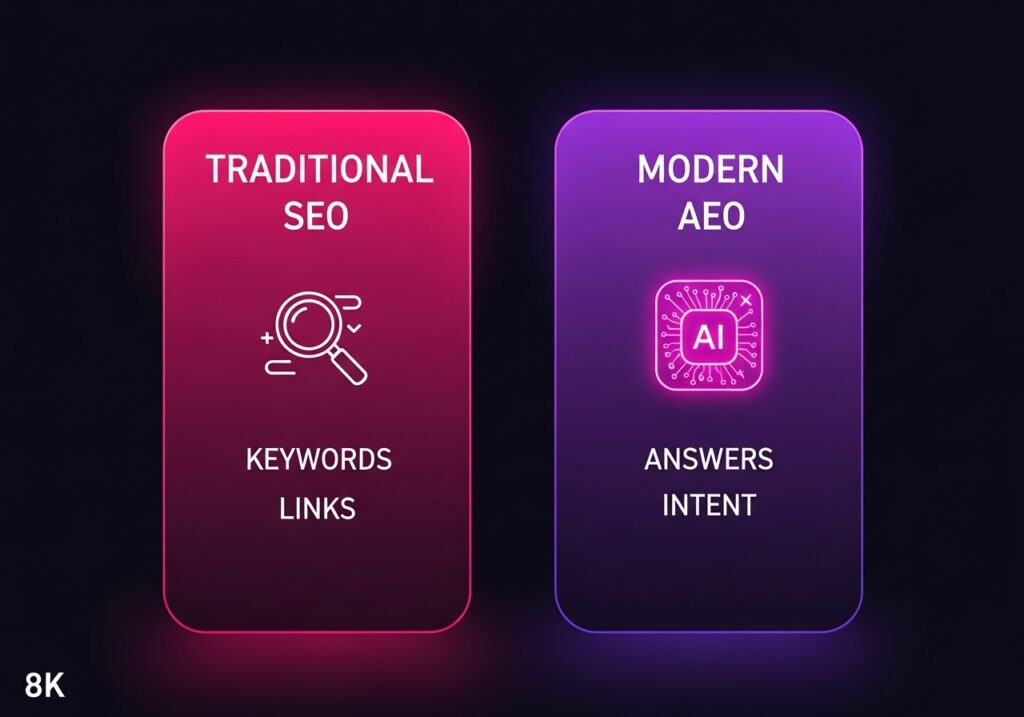
For years, we’ve told clients that content is king. In the world of AEO, Context is King.
Google’s introduction of SGE (Search Generative Experience), now known as AI Overviews, has fundamentally changed the anatomy of a search. Now, the top of the page is occupied by a synthesized summary.
To get featured in that summary, your content needs to move away from "keyword stuffing" and toward Entity-Based SEO. This involves:
- Direct Answer Formatting: Answering the "Who, What, Where, and Why" of your industry in clear, concise language that an AI can easily parse.
- Structured Data (Schema): Giving search engines a "map" of your data so they don't have to guess what your services are.
- Trust Signals: Substantiating every claim with data, case studies, and expert bios (E-E-A-T: Experience, Expertise, Authoritativeness, and Trustworthiness).
The South African Context: Is Our Market Ready?
You might be thinking, "Is this really relevant for my business in Johannesburg or Durban?"
The answer is a resounding yes. South African consumers are among the fastest adopters of mobile technology and AI assistants in the developing world. As data costs fluctuate, the efficiency of getting a single, accurate answer from an AI assistant—rather than browsing five different heavy websites—is becoming the preferred method of discovery.
At Pitch Perfect Marketing, we’ve seen a shift in how our own clients are being discovered. It’s no longer just about being #1 on Google; it’s about being the "Suggested Partner" in a ChatGPT conversation.
The Technical Playbook: Why LLM Optimization is Not a "Plug-and-Play" Solution
Many business owners make the mistake of thinking AEO is just about writing a few FAQs. If only it were that simple! To truly "rank" inside an LLM’s response, you have to understand the bridge between your website’s code and the AI’s Vector Database.
1. The Power of Nested JSON-LD Schema
Traditional SEO uses basic Schema to tell Google "this is a product." LLM optimization requires Nested JSON-LD. We aren't just tagging a page; we are building a Knowledge Graph.
By nesting schemas, you create a semantic map. This allows an AI to understand that Pitch Perfect Marketing isn't just a website—it’s a verified entity with specific expertise in the South African eCommerce sector. When a user asks an AI for a recommendation, the model looks for these "explicit relationships" to verify the accuracy of its response.
The Challenge: One misplaced bracket in your JSON-LD code can render your site unreadable to an AI crawler. This is why a "set it and forget it" approach often fails.
2. Optimizing for RAG (Retrieval-Augmented Generation)
When an AI search engine (like Perplexity) answers a query, it uses a process called RAG. It "retrieves" the most relevant snippets from the live web and "augments" its existing knowledge to generate an answer.
To be the "Retrieved" source, your content must satisfy the "Distance to Authority" metric. AI models calculate the mathematical distance between a query and a data point. If your content is buried under three layers of navigation or lacks clear semantic headers (H1-H4), the "distance" is too far, and the AI will skip you for a competitor who has a leaner, more "crawlable" architecture.
Measuring the Invisible: Sentiment and Citation
In the world of AI, your Brand Sentiment is a ranking factor. LLMs are trained on massive datasets including Reddit, news archives, and social media. If your brand has no "digital footprint" outside of your own website, the AI views you as a low-trust entity.
A study by McKinsey & Company suggests that AI-driven personalization could increase marketing ROI by up to 20%. But that ROI is only accessible to brands that have "Consensus."
At Pitch Perfect Marketing, we don't just optimize your meta tags; we manage your Digital Entity Footprint. This involves ensuring that third-party citations, local South African directories, and industry mentions all align to tell the AI the same story: You are the authority.
Why DIYing Your AI Strategy Often Backfires
The "Gold Rush" of AI has led many to use ChatGPT to write 100 blog posts in a day. Warning: This is the fastest way to get blacklisted. Google’s recent core updates have begun penalizing "scaled content abuse"—AI-generated content that provides no new value. To win in AEO, you need "Information Gain." You need to provide data, insights, or local South African market nuances that don't exist in the AI's training set yet.
Creating this balance—technical schema, high-value content, and entity authority—requires a multi-disciplinary team.
FAQs
Q: Will AEO replace traditional SEO?
A: No. AEO is an evolution of SEO. Think of SEO as your foundation and AEO as the advanced layer that ensures you are visible in the "zero-click" era of search. You still need a fast, well-designed website to convert the traffic that does click through.
Q: How long does it take to see results in AI search engines?
A: Unlike traditional Google rankings which can take 3-6 months, LLM responses depend on the "refresh rate" of the model. However, by implementing technical Schema and RAG-friendly content now, you position yourself to be "re-indexed" as these models crawl the web more frequently.
Q: Is AEO only for big tech companies?
A: Absolutely not. In fact, small-to-medium South African businesses have a unique advantage. Because the local market is less saturated with "AI-ready" content, early adopters can claim the "Authority" spot in their niche before the giants wake up.
Don't Let Your Brand Be Left in the Past
The digital landscape is shifting beneath our feet. The companies that thrive in the next five years won't be the ones with the biggest ad budgets; they will be the ones that the AI trusts most.
Optimizing for LLMs and Answer Engines is a high-stakes game of technical precision. Between managing API-accessible content, Vector-friendly formatting, and Complex Schema architectures, the margin for error is slim.
Are you ready to become the "Default Answer" in your industry?
At Pitch Perfect Marketing, we specialize in bridging the gap between traditional SEO and the future of AI Search. We don't just help you rank on page one; we help you become the authority that the world’s smartest models recommend.
Enquire Today for an AI-Readiness Audit
Let’s see how the world’s leading AI models view your brand—and how we can fix it.