
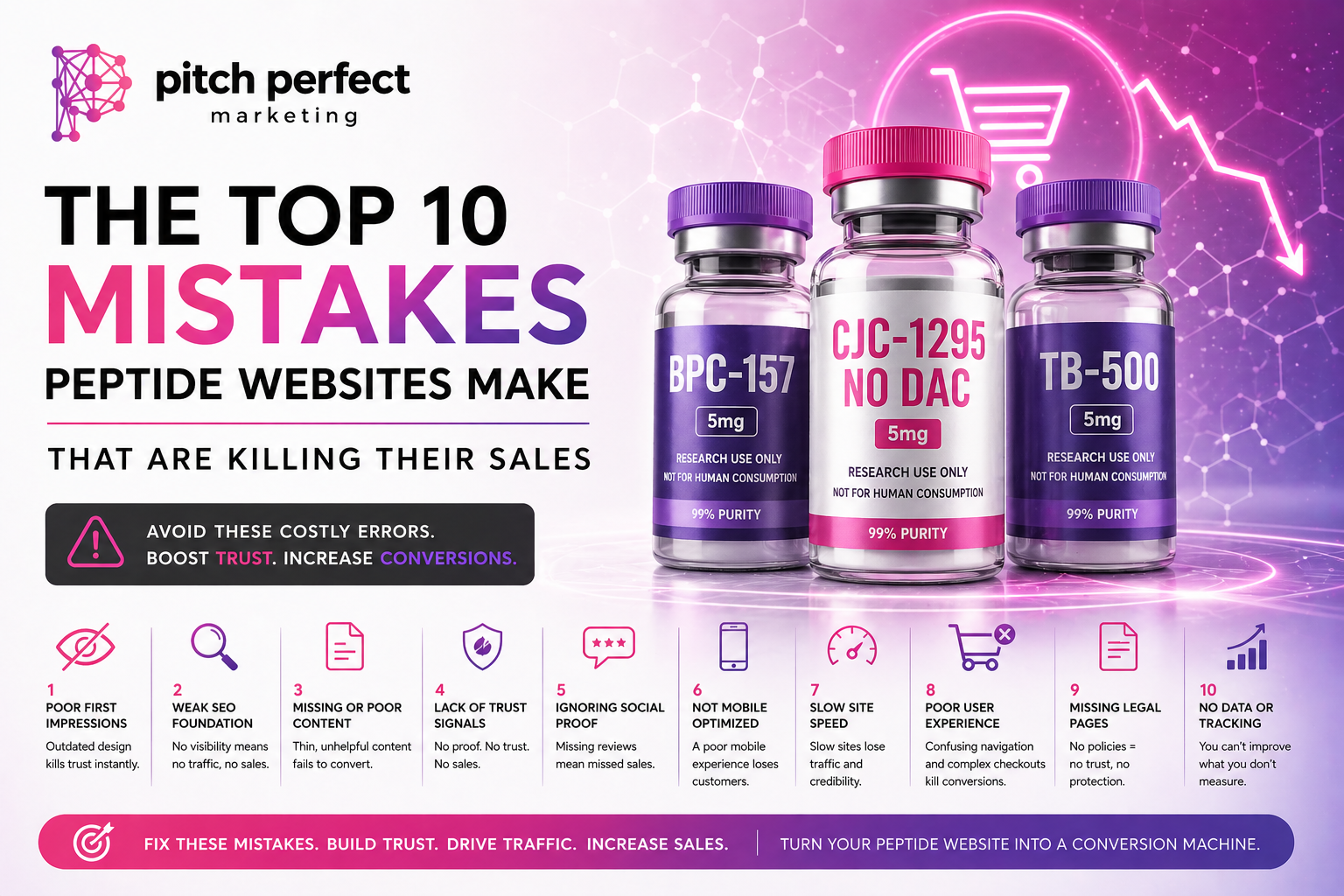
Most peptide websites don’t fail because of bad design—they fail because they break trust.
The biggest issues:
- Fake or unverifiable COAs
- No sourcing transparency
- Poor or missing dosing guidance
- Unsafe payment processes
- Zero real-world credibility
Fix trust, and sales follow. Ignore it, and even the best-looking site won’t convert.
Optimize for the Future of Search
Ready to build Trust & Authority? Elevate your brand with our expert SEO, AEO, and GEO strategies.
Earlier today I was sent a link to a new peptide website in a group I am part of. The context was simple: a new supplier had launched and people were starting to share it around.
When I opened the site, my first impression was genuinely positive. The branding was clean, the layout was minimal, and the overall aesthetic felt closer to a high-end DTC brand than the typical cluttered peptide stores you usually see. It immediately signalled that someone had invested time and money into making this look legitimate.
So I did what any real buyer would do. I created an account, logged in, and started browsing the catalogue properly instead of just skimming the homepage. Within a few minutes I found a product I was actually interested in purchasing. At that point, the site had done its job. It had taken me from curiosity to intent.
But in this space, intent is not enough. The final decision always comes down to verification.
So I messaged the owner and asked for a COA.
What I received back was a disappearing image. No downloadable file, no lab reference I could verify, and no way to keep a record of it. Even worse, it was immediately obvious that the document itself was not legitimate. The formatting, the structure, and the inconsistencies made it clear that it had been AI-generated rather than issued by a real lab.
That single moment erased everything the site had done well.
The design no longer mattered. The branding no longer mattered. The product itself no longer mattered.
Because the one thing that matters in this category had been broken: trust.
And once that is gone, there is no recovery. Not for that session, and most likely not for that customer ever again.
The Fundamental Misunderstanding in the Peptide Market
Most peptide brands are operating under the assumption that if they make their website look professional, customers will feel confident enough to buy. That assumption might work in low-risk categories, but it does not apply here.
When someone is buying peptides, they are not making a casual purchase. They are making a decision that involves risk, uncertainty, and a level of technical understanding. The questions running through their mind are not superficial. They are trying to determine whether the product is legitimate, whether it is safe, and whether the business behind it is credible.
If your website does not actively answer those questions, it creates friction. If it creates friction, it creates hesitation. And hesitation, in almost every case, leads to abandonment.
10 Mistakes That Are Quietly Killing Your Sales
1. Providing Fake or Unverifiable COAs
There is no faster way to lose a serious buyer than by failing this test. In my case, the disappearing image was already a red flag, but the real issue was that the document itself could not be trusted. A legitimate COA should be a stable, verifiable document that includes a real lab name, batch-specific data, and consistent formatting that aligns with industry standards.
When a buyer asks for a COA, they are not asking out of curiosity. They are asking because they are close to purchasing and need final confirmation. If what you provide cannot be verified, you are not just failing to close the sale—you are signalling that the entire operation may be unreliable.
What is in your product you don't want your customer to know about. And if the reality is YOU don't even know what's in your product, you should not be selling it in the first place. Gambling with people's health and safety is not a way to make a quick buck.
2. No Transparency Around Source or Manufacturing
Another pattern I see repeatedly is the complete absence of information about where peptides are produced. There is often no mention of the manufacturing facility, no indication of whether GMP standards are followed, and no explanation of how quality is controlled.
From the buyer’s perspective, this creates a gap that is impossible to ignore. Most people are not trying to bypass suppliers and go directly to labs. They understand the convenience of buying through a reseller. But that convenience only works if there is confidence in the supply chain. If you cannot explain where your products come from, the assumption becomes that you either do not know or do not want to say - and both come across as incredibly shady.
3. Pricing That Feels Arbitrary or Exploitative
Experienced buyers have a general sense of what peptides cost. When pricing is significantly higher than expected without any supporting explanation, it creates suspicion rather than perceived value.
If you are charging a premium, you need to justify it clearly. That justification could come from better sourcing, more rigorous testing, or stronger quality control. But if none of that is communicated, the pricing feels disconnected from reality, and buyers begin to question whether they are being taken advantage of.
Optimize for the Future of Search
Ready to build Trust & Authority? Elevate your brand with our expert SEO, AEO, and GEO strategies.
4. Missing or Incorrect Dosing Information
This is not just a conversion issue; it is a credibility issue. When dosing information is vague, inconsistent, or entirely absent, it signals a lack of expertise. Buyers in this space are often informed, or at the very least cautious. If they cannot find clear guidance, they will not proceed confidently.
For example, listing a peptide without any context around typical usage or expected dosing ranges forces the user to leave your site and search elsewhere. If they don't know how much they need to take and how often, they cannot calculate how many vials they need to buy. At that point, you have lost control of the decision-making process.
5. No Reconstitution Guidance
It is surprisingly common to see peptide products listed without any explanation of how they should be prepared. From a business perspective, this might seem like an oversight. From a user perspective, it feels like negligence.
If someone purchases a product and does not know how to use it safely, the responsibility falls back on the brand. Providing clear, structured instructions does not just improve usability; it reinforces the idea that you understand the product and care about the customer’s experience.
6. Lack of Accessible Contact Information
When a website makes it difficult to contact the business, it introduces uncertainty. Buyers start to wonder what will happen if something goes wrong, if an order does not arrive, or if there is an issue with the product.
Even something as simple as a visible email address, a responsive chat function, or a clearly listed contact method can significantly improve trust. Without it, the site feels distant and unaccountable.
7. Unsafe or Unprofessional Payment Methods
Payment is one of the final steps in the conversion process, and it is also one of the most sensitive. If the only available options are methods that offer no protection, such as direct transfers, it forces the buyer to take on all the risk.
Many people in this space have already experienced scams. They are not willing to repeat that experience. Recognised payment gateways and secure processing are not just technical features; they are signals that the business operates within acceptable standards.
8. No Social Proof or External Validation
A website that exists in isolation, without reviews, testimonials, or any visible community presence, feels untested. Buyers look for signs that other people have purchased, used, and benefited from the product.
Even a small number of detailed, believable reviews can shift perception significantly. Without them, the brand feels unproven.
9. No Incentive for Higher-Value Purchases
Most peptide users do not buy a single product. They build stacks. If your site does not accommodate this behaviour through bundle options or pricing incentives, you are leaving revenue on the table.
More importantly, you are missing an opportunity to guide the user toward a more complete solution. Bundles are not just about discounts; they are about structuring the purchase in a way that aligns with how people actually use these products.
10. Focusing on Design Instead of Decision-Making
The site I saw today is the perfect example of this. It looked exceptional, but it failed at the exact moment where it needed to convert. Design created interest, but it did not create confidence.
A high-converting peptide website is not just visually appealing. It is structured to answer questions, remove doubt, and guide the user toward a decision. Without that structure, design becomes superficial.
The Real Problem — You Are Not Building for Trust
What all of these mistakes have in common is that they ignore the core requirement of this market. You are not just selling products; you are asking for trust in a high-risk category.
Every missing detail, every vague explanation, and every unverifiable claim adds friction. And in a space like this, friction does not reduce conversion slightly—it stops it entirely.
Let Me Help You Build Trust & Authority With Your Customers
If your peptide website looks good but is not generating consistent sales, the issue is not your traffic and it is not your design. The issue is that your site is not structured to build and maintain trust throughout the buying process.
If you want to understand exactly where your site is losing customers and how to fix it, request a full audit and get a clear breakdown of what is costing you revenue.