
Key Takeaways
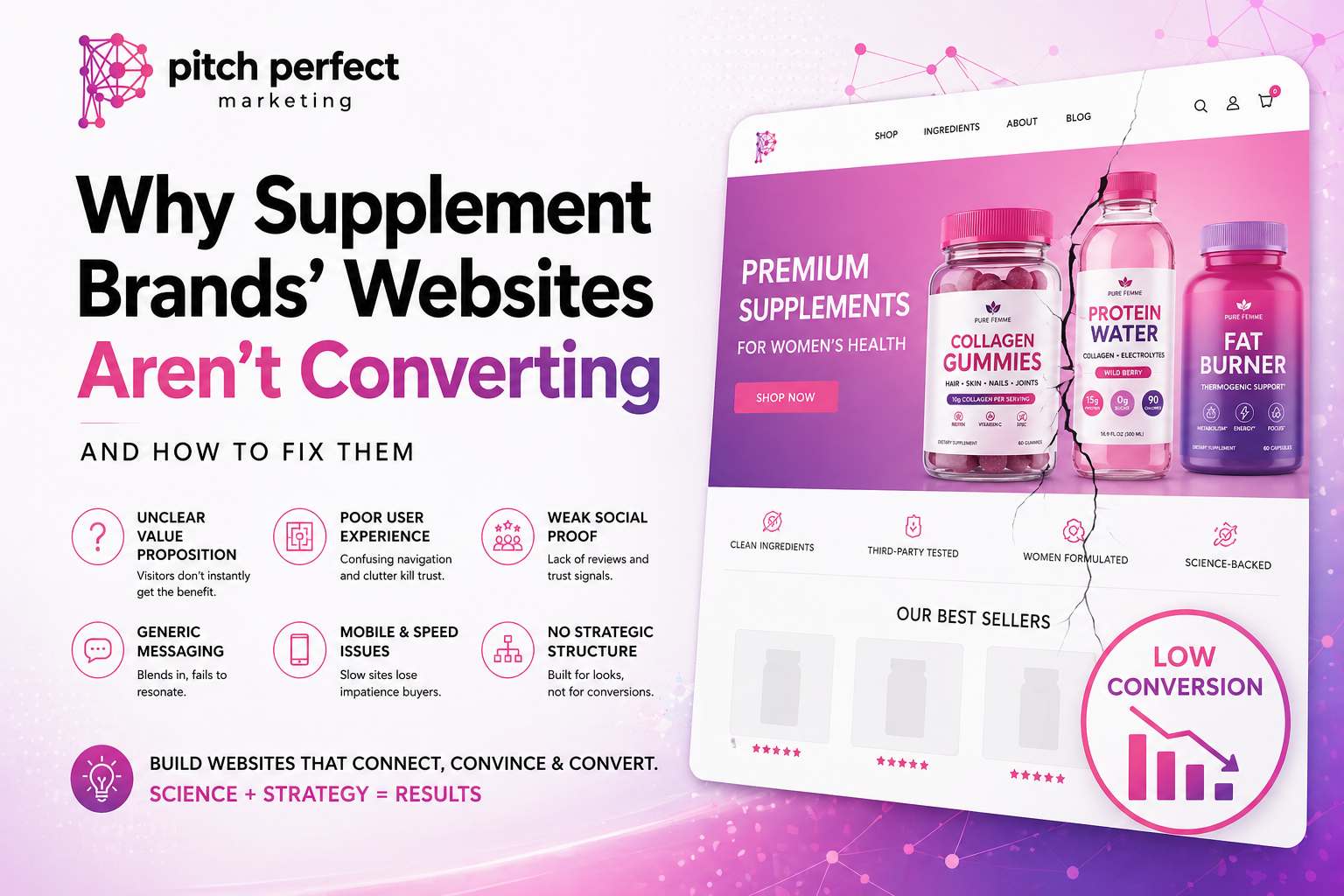
Most supplement websites don’t convert because they fail at three critical layers:
- Trust → Users don’t believe your product
- Clarity → Your value proposition is weak
- Structure → Your product pages don’t guide decisions
Fix those, and conversions follow.
_____________________________________________________________________________
If you’ve ever shopped for supplements online, you already know the problem. You land on a website that looks decent—but within seconds, doubt creeps in:
- Where are these ingredients sourced from?
- Is this actually dosed properly?
- Are these reviews even real?
- Why does this feel… generic?
And then you leave. Not because you weren’t interested—but because you didn’t trust it enough to buy. This is exactly what’s happening on your website. Most supplement brands don’t have a traffic problem – in fact, you probably get a LOT of traffic. They have a trust and conversion architecture problem.
And until that’s fixed, more traffic just means more lost revenue.
Your supplement website isn’t converting because:
- It lacks trust signals (EEAT failure)
- The UX creates friction
- Product pages don’t answer buyer questions
- Traffic intent doesn’t match the offer
- There’s no clear decision path
Problem #1 — Your Website Doesn’t Build Trust Fast Enough
What I consistently see:
The #1 issue across supplement sites is lack of transparency.
- No clear ingredient sourcing – is the product pure? Was it manufactured to GMP standards?
- No explanation of dosage – how many must I take? How long will one bottle last?
- No real authority behind the product – who owns this brand? Do they know what they’re talking about?
- Generic, templated product descriptions – has this been copy pasted by AI? Is this a scam website?
- You haven’t clearly demonstrated that your product solves their problem
- No reviews
From a buyer’s perspective, this screams:
“I don’t know if I should trust this.”
Why This Kills Conversions
Supplements are not impulse buys.
They sit in a category where:
- People are putting something into their body
- Risk perception is high
- Skepticism is default
If trust isn’t established within seconds, the sale is gone.
The Fix
You need:
- Ingredient breakdowns (not just lists, be honest about what’s in your product because it’s going into their body)
- Source transparency (where + how it’s made)
- Real proof (not stock testimonials – even if you have to get opinions from friends and family, authentic feedback is non-negotiable. People can smell a fake review from a mile away)
- Authority signals (who formulated this? – there’s a BIG difference between an anonymous owner & for example, Brad Smith: Personal Trainer & Certified Nutritionist of 15 years)
Problem #2 — Your UX Is Quietly Killing Sales
Most supplement sites don’t look bad. They just don’t guide decisions. Perhaps you got too caught up in the aesthetics of it all and forgot about functionality. It happens – but function and form must ALWAYS be balanced.
What’s Actually Happening
Users land on your product page and:
- Don’t know what to look at first
- Don’t understand the key benefit
- Get overwhelmed by clutter
- Have to “figure things out”
That friction = drop-off.
Example Pattern I See Often
- Hero section = vague headline, no USPs, search intent has not been touched on
- Benefits buried halfway down (or nowhere in sight)
- No visual hierarchy
- CTA not reinforced
Result:
User scrolls → hesitates → leaves
The Fix
Structure your product pages like a decision funnel:
- Clear outcome (above the fold) – e.g. Stubborn belly fat? Torch it for good with our hormone-balancing fat burner – developed for women like you
- Key benefits (fast scanning) – e.g. Balance Hormones | Target Visceral Fat | Boost Energy & Mood | Appetite Control
- Proof (reviews, data)
- Ingredients (explained) – Locally sourced ingredients, full list of what’s inside and why (what each ingredient does to solve the problem)
- FAQs (objections handled) – e.g. How long will it take to see results? How long will one bottle last? Does it have any side effects? What time of the day should I take it?
- CTA (repeated, clear) – e.g Try it for yourself. Shop Now
Problem #3 — You’re Attracting the Wrong Traffic
This is where SEO mistakes compound the issue.
What Most Brands Do
- Target high-volume keywords (e.g. just “fat burner”)
- Ignore intent
- Rank for “informational” queries (e.g. the window shoppers of the eCommerce world)
What Happens
You get traffic from people who:
- Are researching, not buying
- Aren’t ready to convert
- Don’t match your product positioning
The Fix
You need intent-driven SEO:
- “Best [product] for X”
- “Buy [product] online”
- “X supplement benefits vs Y”
Not:
- “What is creatine”
Problem #4 — Your Product Pages Are Structurally Broken
This is the silent killer for not only supplement brands, but any eCommerce store.
Most Pages Look Like This:
- Image
- Short description
- Price
- “Add to cart”
That’s not enough.
What High-Converting Pages Do
They remove doubt step-by-step:
- What is it?
- Why does it work?
- Is it safe?
- Does it work for me?
- Can I trust this brand?
The Fix
Add:
- Benefit breakdowns
- Ingredient explanations
- Comparison sections
- FAQs
- Strong social proof
What This Is Actually Costing You
This is the part most brands underestimate.
If your conversion rate is:
- 1% instead of 3%
- On 10,000 monthly visitors
You’re losing 66% of potential revenue
And most brands try to fix this by:
→ Buying more traffic
Which just amplifies the problem. Because 9 times out of 10, you’re targeting the wrong people there too.
The Real Fix
This is not an SEO issue. This is not a design issue. This is a system failure across:
- Traffic quality (SEO)
- User experience (UX)
- Conversion logic (CRO)
- Trust signals (EEAT)
- AI visibility (AEO)
The Brands That Win Combine:
- Intent-driven SEO
- Conversion-first design
- Trust-based positioning
- Structured, AI-readable content
Ready to start converting?
If your supplement brand is getting traffic but not converting, you don’t need more visitors. You need to fix the system that turns visitors into buyers.
→ Request a full conversion + SEO audit